Chemical safety at IFA
How is chemistry safety organised?
How is chemistry safety organised?
Each laboratory that works with chemistry must have a laboratory manager responsible for the chemical safety. At the entrance to the room, you will find information about who the laboratory manager is. The laboratory manager must ensure:
- That those who are to work with chemicals have received the correct instruction
- That chemical are labelled and stored correctly
- That the necessary personal protection equipment is available
- That safety data sheets (SDS) are available for the all chemicals being used in the workspace
- That a chemical risk assessment is available
- Correct information has been provided regarding the disposal of used chemicals
- That information is provided regarding first aid and firefighting measures and well as possible physical or chemical incidences
It is the responsibility of the Chemical Safety Committee to advise and approve compliance with the above.
AU Green Guide
AU Green Guide
AU has published a new guide to sustainable laboratories, which includes a series of initiatives to reduce CO2 emissions in AU’s labs. You are encouraged to read the recommendations in the guide and think about how a greener workday can be implemented in the lab.
The guide is divided into 4 different themes: chemicals, energy, gasses, and waste management. Read it here.
The guide was created by a broadly representative working group that included lab technicians, facilities staff and OSHA representatives and part of the AU climate action plan in 2022.
The guide has been reviewed and approved by the faculty leadership for Natural Sciences, Technical Sciences og Health. In case of questions about the recommendations in the guide, you are welcome to contact Morten Dam Rasmussen, who is responsible for work environment and head of the working group for CO2-reduction in laboratories at AU.
What do I do if I need to get started in the laboratory?
What do I do if I need to get started in the laboratory?
We advise and help implement safety procedures for new or already used chemicals. Please contact us if you need help, advice or guidance. We find that it is often more time-consuming than you might think to initiate new procedures. We therefore encourage you to contact us in well in advance, preferably 3-4 weeks before you start.
What to do in practice:
Please write to us at kemisikkerhed@phys.au.dk. Tell us which chemicals you want to work with, please attach safety data sheets. Tell us which chemical mixtures you want to work with. How these mixtures are produced. Please provide as much information about the entire process as possible from the outset, in order make our work process easier and to help us to provide with quicker and more precise advice. You should also be aware of any waste chemicals that need to be disposed of afterwards. We will receive your case and will issue questions within two weeks. When all of the information is in position, we create your chemicals and chemical processes in our chemical database. Via a web interface, you can pull all the information necessary to maintain a high level of security. You will be able to find:
- Safety data sheets
- Clarity about known risks
- Clarity about the types of personal protective equipment to be used
- Chemical risk assessments
- Clarity about known risks
- Clarity about the types of personal protective equipment to be used
- Labels for termination of enrolment
- Correct labelling of your own mixtures
- Information about waste management
- Packaging and labelling.
Procurement of chemicals
Procurement of chemicals
Chemical Purchases – Understand the Risks Before You Buy
When purchasing chemicals, it is a requirement to familiarize yourself with the potential hazards associated with the chemical, its usage, storage, and disposal before making the purchase.
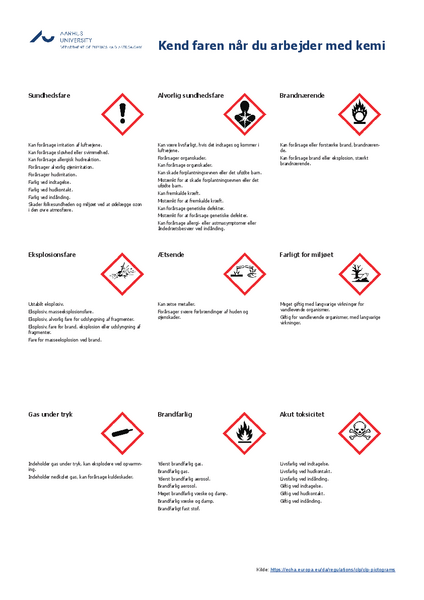
All chemicals are labeled with CLP pictograms, which indicate the hazards associated with the chemical. Each pictogram is further explained with hazard statements that provide specific information about the chemical’s dangers.
Heightened Awareness
Special attention should be given to “Serious Health Hazard,” “Oxidizing,” “Explosive,” “Flammable,” and “Acute Toxicity.”
Be aware that there may be specific regulations for the use, storage, and disposal of chemicals.
Furthermore, it is important to be aware of any potential hazards when using the chemical in combination with other substances. Information about this is typically found in the chemical’s safety data sheet (SDS), under section 10: Stability and Reactivity.
If in doubt, consult the safety organization: kemisikkerhed@phys.au.dk
Chemical labelling
Chemical labelling
Handling and labelling of hazardous chemicals
All hazardous chemicals, mixtures and materials purchased must be correctly labelled with CLP hazard labelling. The same applies to dilutions and mixtures made in the laboratory or workshop – these must also be correctly labelled.
CLP – Classification, Labelling and Packaging
CLP is a regulation defined in EU Regulation No. 1272 of 2008. This Regulation has harmonised the previous EU rules with the Global Harmonized System of Classification and Labelling (GHS) rules.
The GHS system makes it easy and understandable for carriers and users around the world to know what precautions to take when handling hazardous substances.
CLP Marking
CLP labelling looks like this:


The individual pictograms in the CLP marking each have their own meaning. It is therefore important as a user to know these.
You can find more information about the pictograms via this link:
https://www.ecoonline.com/da/blog/faremaerkning-og-farepiktogrammer (text in Danish).
A poster with pictograms and explanations can be downloaded here:
Always check the safety data sheet
In addition to correct labelling of the chemicals, it is important to always check that the chemical is labelled in accordance with the associated safety data sheet.
Handling of old chemical labelling
If you as a user find hazardous chemicals labelled with old, orange coloured hazard labels such as these:


... This means that the chemical is not properly labelled and does not comply with the applicable regulations. In such cases, you should contact the laboratory manager, who will assess whether the chemical should be disposed of or replaced with a new purchased version.
Assessment of the continued use of the chemical
The following factors must be assessed before a decision is made to keep a chemical:
- Is it possible to obtain a new chemical?
- Is the cost of procuring a new chemical too high?
- Is the packaging intact?
- Is the packaging suitable for storing the fabric/material?
- Are the current storage conditions appropriate?
- What are the disposal options and what are the costs associated with these?
If necessary, contact the Chemical Safety Group for further guidance on disposal.
Note for plastic packaging:
Plastic packaging has a limited shelf life and is typically not recommended for use after 5 years from the date of manufacture. Chemicals that are to be retained but stored in older plastic packaging must be poured into a new and suitable container.
If the chemical is to be retained:
Ensure proper CLP labelling.
Obtain an updated safety data sheet and register it.
On the basis of the safety data sheet, it must be assessed whether the necessary safety measures for the storage and handling of chemicals can be complied with.
If you need help or further guidance, you can contact the Chemical Safety Group.
Chemical waste
Chemical waste
There are strict requirements for the disposal of chemicals, both with regard to transport and, not least, packaging and labelling. It is therefore very important that you contact us before you begin the disposal of chemicals. We would like to make sure that packaging and labelling are correct from the outset, as this reduces our work and ensures that everything is done as the law prescribes. If you have chemical waste, please contact us and we will provide you with labels and correct packaging.
What should I do about chemical accidents?
What should I do about chemical accidents?
Chemical spill
Chemical spill
Instructions on how to use the Spill Kit Box
Purpose:
The spill kit box is intended for the quick and safe handling of minor chemical spills in order to minimize the risk of personal injury, poisoning, and environmental impact.
By reacting quickly, you can prevent spreading, reduce the risk of exposure, and avoid damage to furnishings and equipment.
What does the spill kit box contain?
Protective equipment:
- 2 gas masks – half masks
- 2 sets of filters for gas masks (broad spectrum)
- 4 pairs of heavy-duty chemical-resistant gloves
- 10 shoe covers
Absorption and cleaning materials:
- 3 plastic buckets
- Vermiculite (in the innermost plastic bucket)
- Scoop for vermiculite
- 1 broom and dustpan set
- 10 fiber cloths
- 1 pack of paper towels
Waste handling:
- 10 cable ties
- 1 roll of waste bags
First aid:
- 1 pack of compress bandages
Important information:
Do not use the spill kit for large spills or for dangerous chemicals such as strong acids/bases, mercury, or solvents with high volatility.
If in doubt, contact the chemical safety group and the laboratory manager!
Before laboratory work begins, you as the user must, as part of the chemical workplace assessment, check that the contents of the spill kit are suitable for the chemicals being used.
- Check that the gloves are suitable for these chemicals and note their breakthrough time in relation to the substances in use.
- Ensure that the respirator filters are appropriate for the vapors or gases that may potentially be released.
- Always check that the spill kit is intact and contains all the necessary safety equipment for the planned work.
As a user, you are responsible for identifying any deficiencies and contacting the laboratory manager or chemical safety group if the equipment needs to be replenished or replaced.
What should I do if an accident occurs and there is a chemical spill?
- Isolate the area
- Block off and contain the area to prevent spreading
- Inform people in the room and evacuate if necessary
- For liquid chemical spills: open windows for fresh air, if safe
- For solid chemicals: avoid dust formation
- Identify the substance
- Always check the Safety Data Sheet (SDS) for instructions on handling and disposal of the chemical
- Use appropriate protective equipment
- Always wear safety goggles
- If necessary, put on gas mask and suitable gloves
- Use shoe covers
- Collect the spill
- For liquid spills: spread vermiculite over the liquid and carefully collect with the scoop
- For solid chemicals: carefully use the dustpan and broom without creating dust
- Use fiber cloths or paper towels for any remaining residue on surfaces
- Clean the area thoroughly afterward with appropriate cleaning agents
How do I dispose of the collected spill?
- Collect the spill, used vermiculite, cloths and paper towels, gloves, and shoe covers in one of the buckets with its lid
- Place the bucket in a bag and seal the bag carefully with cable ties
- Label the bag with the chemical name and note that it contains absorbed spill
- Deliver the bag to the fume hood in room 1522-411
Do I need to notify anyone about the spill/accident?
The chemical safety group and the laboratory manager must be contacted immediately.
If you suspect exposure
If you suspect you have been exposed during the spill/accident, you must immediately leave the area and seek fresh air or rinse the affected area with plenty of water (e.g., in case of skin or eye contact).
If symptoms occur – seek first aid immediately.
Contact the on-call doctor or dial 112 in case of severe symptoms (e.g., breathing difficulties, dizziness, rash, or irritation).
The safety organization and the laboratory manager must be notified as soon as possible after the incident.
Protective equipment
Protective equipment
Types of protective equipment
To ensure a good, safe, and healthy working environment in the laboratory, it is in many cases required that protective equipment is used when working in the laboratory.
The protective equipment helps to increase the safety of the users and others present in the room.
It is important to point out that all users of the chemistry laboratories are obliged to use protective equipment when required by the safety data sheet and the Process WPA.
As a user of protective equipment, you must have received instruction in the use of these and be aware of any defects or deficiencies in the protective equipment.
At the chemistry laboratories, several different types of protective equipment are used. The common protective equipment used can be mentioned: lab coats, fume cupboards and local exhaust ventilation, safety glasses and gloves.

In specific cases it can be necessary to use other, more specialized protective equipment. In these cases, it must be approved by the chemical safety group.
